THANK YOU FOR SUBSCRIBING

× 
Education Technology Insights Weekly Brief
Be first to read the latest tech news, Industry Leader's Insights, and CIO interviews of medium and large enterprises exclusively from Education Technology Insights

SmartScan
Turning Assessments into Academic Intelligence

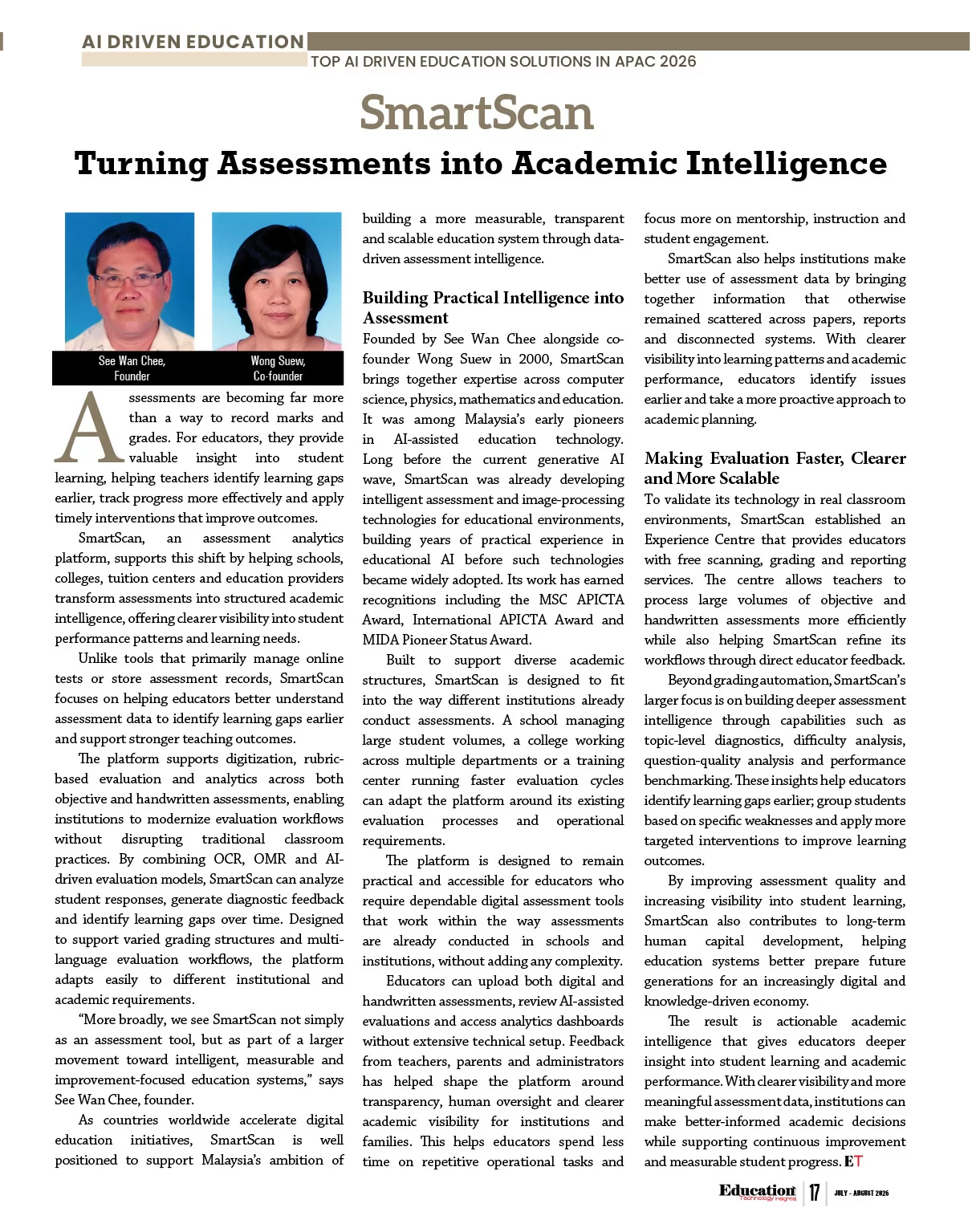
 See Wan Chee, Founder and Wong Suew, Co-founder
SmartScan, an assessment analytics platform, supports this shift by helping schools, colleges, tuition centers and education providers transform assessments into structured academic intelligence, offering clearer visibility into student performance patterns and learning needs.
Unlike tools that primarily manage online tests or store assessment records, SmartScan focuses on helping educators better understand assessment data to identify learning gaps earlier and support stronger teaching outcomes.
The platform supports digitization, rubric-based evaluation and analytics across both objective and handwritten assessments, enabling institutions to modernize evaluation workflows without disrupting traditional classroom practices. By combining OCR, OMR and AI-driven evaluation models, SmartScan can analyze student responses, generate diagnostic feedback and identify learning gaps over time. Designed to support varied grading structures and multi-language evaluation workflows, the platform adapts easily to different institutional and academic requirements.
“More broadly, we see SmartScan not simply as an assessment tool, but as part of a larger movement toward intelligent, measurable and improvement-focused education systems,” says See Wan Chee, founder.
As countries worldwide accelerate digital education initiatives, SmartScan is well positioned to support Malaysia’s ambition of building a more measurable, transparent and scalable education system through datadriven assessment intelligence.
Building Practical Intelligence into Assessment
Founded by See Wan Chee alongside co-founder Wong Suew in 2000, SmartScan brings together expertise across computer science, physics, mathematics and education. It was among Malaysia’s early pioneers in AI-assisted education technology. Long before the current generative AI wave, SmartScan was already developing intelligent assessment and image-processing technologies for educational environments, building years of practical experience in educational AI before such technologies became widely adopted. Its work has earned recognitions including the MSC APICTA Award, International APICTA Award and MIDA Pioneer Status Award.
Built to support diverse academic structures, SmartScan is designed to fit into the way different institutions already conduct assessments. A school managing large student volumes, a college working across multiple departments or a training center running faster evaluation cycles can adapt the platform around its existing evaluation processes and operational requirements.
The platform is designed to remain practical and accessible for educators who require dependable digital assessment tools that work within the way assessments are already conducted in schools and institutions, without adding any complexity.
More broadly, we see SmartScan not simply as an assessment tool, but as part of a larger movement toward intelligent, measurable and improvement-focused education systems.

Educators can upload both digital and handwritten assessments, review AI-assisted evaluations and access analytics dashboards without extensive technical setup. Feedback from teachers, parents and administrators has helped shape the platform around transparency, human oversight and clearer academic visibility for institutions and families. This helps educators spend less time on repetitive operational tasks and focus more on mentorship, instruction and student engagement.
SmartScan also helps institutions make better use of assessment data by bringing together information that otherwise remained scattered across papers, reports and disconnected systems. With clearer visibility into learning patterns and academic performance, educators identify issues earlier and take a more proactive approach to academic planning.
Making Evaluation Faster, Clearer and More Scalable
To validate its technology in real classroom environments, SmartScan established an Experience Centre that provides educators with free scanning, grading and reporting services. The centre allows teachers to process large volumes of objective and handwritten assessments more efficiently while also helping SmartScan refine its workflows through direct educator feedback.
Beyond grading automation, SmartScan’s larger focus is on building deeper assessment intelligence through capabilities such as topic-level diagnostics, difficulty analysis, question-quality analysis and performance benchmarking. These insights help educators identify learning gaps earlier; group students based on specific weaknesses and apply more targeted interventions to improve learning outcomes.
By improving assessment quality and increasing visibility into student learning, SmartScan also contributes to long-term human capital development, helping education systems better prepare future generations for an increasingly digital and knowledge-driven economy.
The result is actionable academic intelligence that gives educators deeper insight into student learning and academic performance. With clearer visibility and more meaningful assessment data, institutions can make better-informed academic decisions while supporting continuous improvement and measurable student progress.
Turning Assessment Data into Teaching Judgment
Every assessment tells a story, but too often educators do not have the time to fully understand what it says. Once exams are completed, teachers are left with stacks of papers to grade, results to compile and reports to prepare. By the time the process is finished, valuable opportunities to identify learning gaps or adjust instruction may already have passed. As class sizes grow and administrative demands increase, schools are looking for ways to make assessment data more useful without adding to teachers’ workloads.
That is why assessment technology is no longer judged solely by grading speed. Educators certainly appreciate anything that reduces marking time, but what they value most is a clearer understanding of how students are learning. Schools, colleges and training providers need tools that can handle different assessment formats while fitting seamlessly into everyday teaching practices. The best platforms do not try to replace teacher expertise. Instead, they help reduce the administrative workload, giving educators more time to focus on what matters most, supporting students and helping them succeed.
For many institutions, the challenge is not collecting data but making sense of it. Assessment results often end up spread across spreadsheets, reports and disconnected systems, making it difficult to see larger patterns. A struggling student may not be identified early enough. A recurring concept gap across an entire class may go unnoticed until the next exam cycle. The most effective assessment platforms help educators move beyond individual scores and identify trends, giving them a clearer understanding of student progress and areas where additional support may be needed.
Ease of use matters just as much as what a platform can do. Teachers already spend their days balancing lesson planning, grading and classroom responsibilities, so new technology should make that work easier, not add another learning curve. The best assessment tools fit naturally into existing routines, helping educators review AI-assisted evaluations, make adjustments when needed and confidently communicate results. While AI can reduce the time spent on grading, meaningful assessment still depends on teacher judgment. The real value of technology lies in giving educators better insights and more time to focus on their students.
“SmartScan is designed to help institutions get more value from the assessment process. The platform supports both objective and subjective assessments, rubric-based marking, multilingual evaluation workflows and flexible scoring structures that can adapt to different academic needs.”
School leaders are also taking a broader view of return on investment. Faster grading matters, but the long-term value often comes from better visibility into student performance, improved academic planning and earlier intervention when learners need support. When assessment data becomes easier to access and act on, it can benefit not only teachers but also administrators, students and parents.
SmartScan is designed to help institutions get more value from the assessment process. The platform supports both objective and subjective assessments, rubric-based marking, multilingual evaluation workflows and flexible scoring structures that can adapt to different academic needs. It can process handwritten and OMR-based assessments, use multilingual OCR and turn assessment results into clear, actionable insights.
This gives educators a better view of learning gaps, student progress and areas where additional support may be needed. By combining AI-assisted evaluation with teacher oversight, SmartScan helps reduce the time spent on administrative tasks while making assessment data more useful for guiding instruction and improving learning outcomes.
...Read more
Info
Q1
What Are AI-Driven Education Solutions and Why Are They Gaining Attention Across APAC?
Schools, colleges and training providers are under pressure to deliver more personalized learning while managing growing student populations and diverse learning needs. AI-Driven Education Solutions help address this challenge by using data, automation and adaptive learning methods to support instruction, assessment and student engagement. Across APAC, interest continues to grow as educators look for practical ways to improve learning experiences without adding unnecessary administrative burden. AI-Driven Education Solutions are increasingly being evaluated for their ability to support both teaching quality and learner outcomes.
Q2
How Does SmartScan Contribute to AI-Driven Education Solutions?
SmartScan has been recognized among the Top AI-Driven Education Solutions in APAC 2026 for its focus on applying artificial intelligence to educational environments. Its work aligns with the growing demand for technology that can assist educators, streamline learning processes and support more responsive educational experiences. Rather than treating technology as an isolated tool, SmartScan operates within the broader movement toward AI-Driven Education Solutions that help institutions make better use of educational data, learner insights and digital learning workflows.
Q3
Which Problems Can AI-Based Learning Technologies Help Solve?
Many educational organizations struggle with inconsistent learner engagement, limited personalization and time-consuming administrative tasks. AI-Driven Education Solutions can help by identifying learning gaps earlier, supporting adaptive content delivery and reducing repetitive manual work. For educators, this can mean spending more time helping students and less time managing disconnected systems. For learners, it often results in more relevant content, faster feedback and a learning experience that better reflects individual progress.
Q4
What Should Organizations Look for When Evaluating Education AI Platforms?
A useful evaluation starts with real classroom or training scenarios rather than feature lists. Decision-makers should examine how AI-Driven Education Solutions handle assessment, learner support, reporting and content adaptation in everyday use. Data privacy, transparency and ease of adoption also matter. The strongest platforms fit naturally into existing teaching workflows instead of creating another dashboard for educators to manage. Long-term value usually comes from measurable improvements in engagement, learning progress and instructional efficiency.
Q5
How Do AI-Driven Education Solutions Support Personalized Learning?
Traditional educational models often deliver the same content to every learner regardless of prior knowledge or learning pace. AI-Driven Education Solutions can adjust recommendations, practice activities and learning pathways based on student performance. This creates a more individualized experience without requiring instructors to manually customize every lesson. In many cases, learners receive guidance when they need it most, while educators gain clearer visibility into areas where additional support may be required.
Q6
What Makes SmartScan Relevant in the Future of Educational Technology?
Educational technology is moving beyond simple digitization toward systems that actively assist learning and decision-making. SmartScan reflects this shift by operating within a category focused on intelligent educational support. Its recognition in APAC highlights growing demand for AI-Driven Education Solutions that combine educational goals with practical technology implementation. As institutions continue exploring adaptive learning, data-informed instruction and scalable student support models, organizations such as SmartScan illustrate how AI can become a useful part of everyday education rather than a standalone experiment.
| Share this Article: Tweet |

Company
SmartScan
Management
See Wan Chee, Founder and Wong Suew, Co-founder
Description
Founded in 2000 and headquartered in Malaysia, SmartScan provides AI-assisted assessment and analytics solutions that help schools, colleges and education providers streamline evaluation workflows, identify learning gaps and transform assessments into structured academic intelligence that supports measurable, improvement-focused learning outcomes.