THANK YOU FOR SUBSCRIBING

× 
Education Technology Insights Weekly Brief
Be first to read the latest tech news, Industry Leader's Insights, and CIO interviews of medium and large enterprises exclusively from Education Technology Insights


Floresh
Connecting Classrooms and Families through Transparent Progress

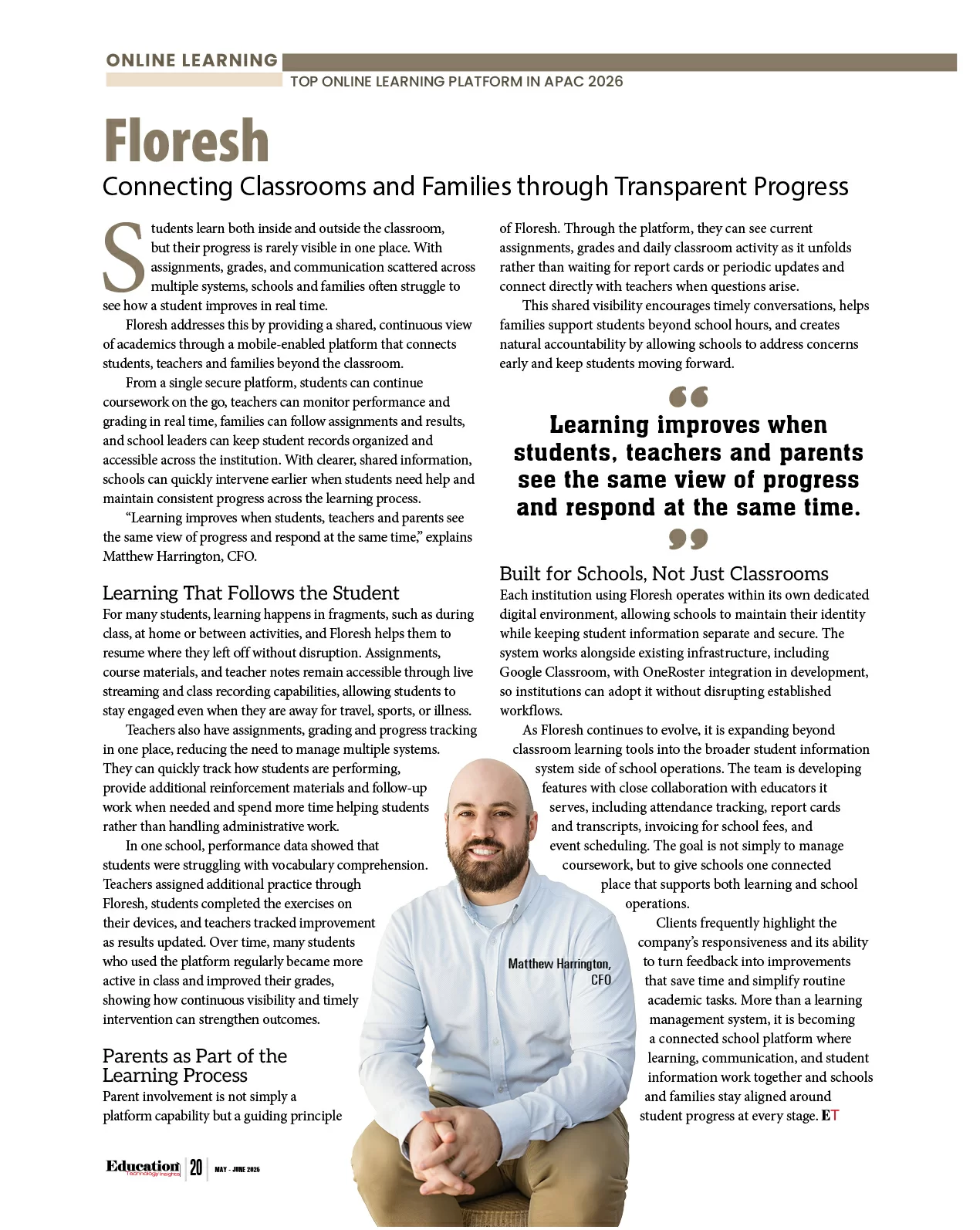
 Matthew Harrington, CFO
Students learn both inside and outside the classroom, but their progress is rarely visible in one place. With assignments, grades, and communication scattered across multiple systems, schools and families often struggle to see how a student improves in real time.
Floresh addresses this by providing a shared, continuous view of academics through a mobile-enabled platform that connects students, teachers and families beyond the classroom.
From a single secure platform, students can continue coursework on the go, teachers can monitor performance and grading in real time, families can follow assignments and results, and school leaders can keep student records organized and accessible across the institution. With clearer, shared information, schools can quickly intervene earlier when students need help and maintain consistent progress across the learning process.
“Learning improves when students, teachers and parents see the same view of progress and respond at the same time,” explains Matthew Harrington, Co-Founder.
Learning That Follows the Student
How does continuous access to coursework support uninterrupted learning across different student environments?
For many students, learning happens in fragments, such as during class, at home or between activities, and Floresh helps them to resume where they left off without disruption. Assignments, course materials, and teacher notes remain accessible through live streaming and class recording capabilities, allowing students to stay engaged even when they are away for travel, sports, or illness.
Teachers also have assignments, grading and progress tracking in one place, reducing the need to manage multiple systems. They can quickly track how students are performing, provide additional reinforcement materials and follow-up work when needed and spend more time helping students rather than handling administrative work.
-
Learning improves when students, teachers and parents see the same view of progress and respond at the same time.
In one school, performance data showed that students were struggling with vocabulary comprehension. Teachers assigned additional practice through Floresh, students completed the exercises on their devices, and teachers tracked improvement as results updated. Over time, many students who used the platform regularly became more active in class and improved their grades, showing how continuous visibility and timely intervention can strengthen outcomes.
Parents as Part of the Learning Process
Why is real-time parental visibility important for supporting student progress and accountability?
Parent involvement is not simply a platform capability but a guiding principle of Floresh. Through the platform, they can see current assignments, grades and daily classroom activity as it unfolds rather than waiting for report cards or periodic updates and connect directly with teachers when questions arise.
This shared visibility encourages timely conversations, helps families support students beyond school hours, and creates natural accountability by allowing schools to address concerns early and keep students moving forward.
Built for Schools, Not Just Classrooms
In what way does Floresh expand beyond classroom tools into broader school operations?
Each institution using Floresh operates within its own dedicated digital environment, allowing schools to maintain their identity while keeping student information separate and secure. The system works alongside existing infrastructure, including Google Classroom, with OneRoster integration in development, so institutions can adopt it without disrupting established workflows.
As Floresh continues to evolve, it is expanding beyond classroom learning tools into the broader student information system side of school operations. The team is developing features with close collaboration with educators it serves, including attendance tracking, report cards and transcripts, invoicing for school fees, and event scheduling. The goal is not simply to manage coursework, but to give schools one connected place that supports both learning and school operations.
Clients frequently highlight the company’s responsiveness and its ability to turn feedback into improvements that save time and simplify routine academic tasks. More than a learning management system, it is becoming a connected school platform where learning, communication, and student information work together and schools and families stay aligned around student progress at every stage.
Evaluating Modern Online Learning Platforms for Institutional Scale
Digital learning infrastructure has moved from supplemental classroom support to a core institutional system that shapes how schools deliver instruction, track performance and communicate with families. Education leaders responsible for selecting an online learning platform face a complicated decision environment. Many systems promise content distribution or assignment management, yet fewer demonstrate how digital learning environments can sustain continuity for students, simplify instructional workflows for teachers and deliver visibility for administrators and parents. Decision-makers now examine platforms through the lens of measurable learning continuity, transparency across stakeholders and long-term adaptability within a school’s digital ecosystem.
Continuity of learning has emerged as one of the most pressing considerations. Students rarely experience learning in a single fixed environment anymore. Absences due to travel, illness, extracurricular commitments have made it necessary for coursework to follow the student rather than remain bound to the classroom. Platforms that function reliably across mobile devices help maintain participation during these interruptions. Mobile accessibility also enables schools to extend instruction beyond the classroom while preserving engagement with ongoing coursework. Systems that allow students to resume assignments exactly where they paused help maintain academic rhythm and reduce the friction that often causes learning gaps in fragmented digital environments.
Institutional transparency represents another major priority for education leaders evaluating learning platforms. School communities increasingly expect clearer insight into academic progress and day-to-day learning activity. Administrators require consolidated information about student performance across classes while parents want timely insight into how their children are progressing. Platforms that provide accessible grade visibility, communication pathways between teachers and families and centralized student information help strengthen accountability across the educational ecosystem. Clear visibility into academic performance allows schools to demonstrate learning outcomes to families while giving administrators the information needed to guide institutional decisions.
Practical classroom usability remains equally important. Teachers operate within intense time constraints, which makes workflow efficiency a defining feature of a viable learning platform. Systems that streamline grading, assignment tracking and feedback reduce administrative burden and allow educators to focus more attention on instruction itself. Learning environments that permit teachers to add reinforcement materials or supplementary guidance without disrupting class time can support deeper student understanding while maintaining classroom flow. When students can complete assignments through familiar personal devices outside school hours, the platform becomes integrated into the rhythm of instruction rather than acting as a parallel administrative tool.
Data visibility also influences how schools refine teaching strategies. Administrators and curriculum leaders increasingly rely on performance patterns within digital platforms to understand where students struggle. Performance insights allow educators to identify learning gaps, adjust materials and introduce targeted practice. Observing where students encounter difficulty in specific topics allows institutions to respond quickly with additional exercises or instructional adjustments, strengthening comprehension before knowledge gaps widen.
Floresh exemplifies how these capabilities can converge within a unified online learning environment. The platform delivers a mobile-first digital learning experience that allows students to continue coursework wherever they are, supporting continuity when students are away from the classroom. It simplifies grading and progress tracking for teachers while providing administrators with centralized access to student information. Floresh also creates separate data environments for each institution, reinforcing trust and data integrity across school systems. Parent visibility into live academic progress encourages family participation in the learning process. Schools using the platform have also applied its analytics to identify vocabulary comprehension gaps and introduce targeted practice exercises, improving student outcomes through data-guided teaching adjustments.
...Read more
| Share this Article: Tweet |

Company
Floresh
Management
Matthew Harrington, CFO
Description
Floresh is an education technology company that provides a mobile-enabled learning platform designed to keep students, teachers, and families connected. The platform helps schools manage assignments, track student progress, and support learning beyond the classroom while giving parents greater visibility into their child’s academic development.